Feralness
H is for HawkFeralness in H Is for Hawk is both a change in an animal’s condition and a charged idea through which people imagine freedom. A goshawk that returns to wild behavior appears to offer an escape from human rules, but the book complicates that fantasy: the hawk remains an animal with its own needs, while human accounts of wildness are shaped by grief, fear, class, and expectations about gender.
The lost hawk and White’s idea of escape
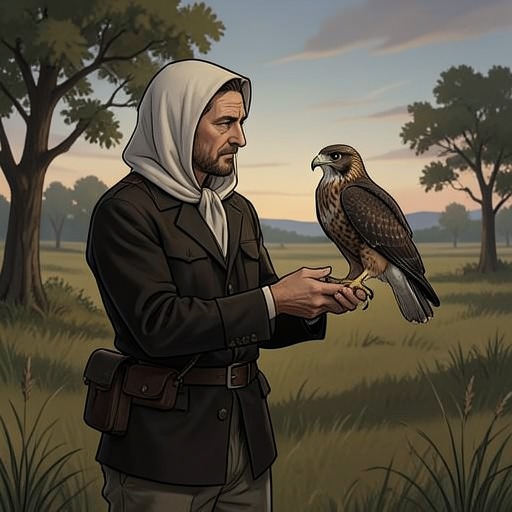
T. H. White encounters the idea through a report by Gilbert Blaine about a lost goshawk. Blaine describes a bird that had been as domesticated as a household parrot on the day she disappeared, but had reverted to a feral state within a week and become a local myth. White is struck by the possibility that such a change might apply to a person as well as a hawk. The thought gathers force amid his fear of approaching war and his sense that modern civilization is unstable and futile. He takes a farm labourer’s cottage for five shillings a week and writes to Germany for a goshawk, joining the wish to escape with the practical undertaking of training a bird.
For White, feralness is not simply an animal’s return to a previous condition. It becomes a way to imagine becoming free, fierce, and outside the conventions that have constrained him. He places difficult, discreditable parts of himself in the figure of the hawk and hopes to train both bird and self. The aspiration is paradoxical: he longs for release from civilization, yet pursues it by trying to master and educate a wild creature. The hawk’s independence is therefore at once the object of his desire and something he seeks to control.
Identification and the limits of transformation
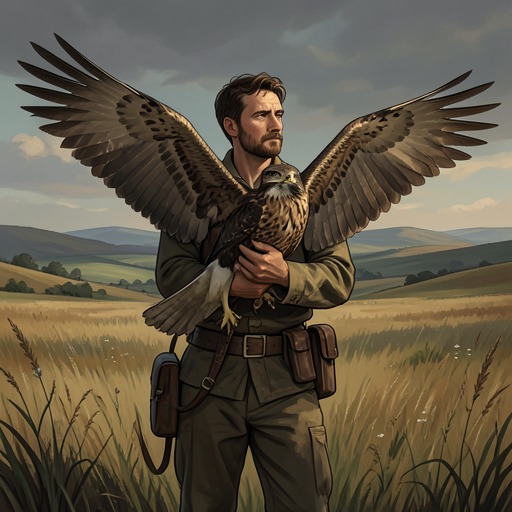
Helen Macdonald’s account gives the idea a different setting. After her father’s death, she is bereaved and unusually susceptible to the hope that a hawk might model a way of living beyond human grief. She has trained many hawks, and the steps involved in Mabel’s training are familiar to her; what is unfamiliar is the person carrying them out while in emotional ruin. Mabel seems to embody solitude, self-possession, and freedom from human hurt, qualities Macdonald longs for in herself.
The contrast between expectation and observation unsettles that identification. Macdonald worries when Mabel sleeps for long periods, wondering whether the hawk is ill. She recognizes that nothing is wrong: Mabel is a baby, and babies sleep. The correction matters because it returns the hawk from symbolic service to a particular living creature with an ordinary explanation for her behavior. Macdonald’s sense of becoming hawk-like is real as an experience of identification, but it does not mean that she has literally crossed into the bird’s nature.
That identification develops through watching. Training requires close attention to the hawk’s moods and signs, until the trainer can anticipate what it may do. For Macdonald, this practiced attention approaches a temporary loss of self: she places herself imaginatively in the hawk’s perspective, and describes her humanity as seeming to burn away. Feralness thus marks both the allure and the risk of imaginative transformation. The closer the human observer feels to the animal, the more important it becomes to distinguish empathy from an assumption that the hawk simply expresses human desire.
Wildness, class, and falconry’s histories
The book also shows that ideas about wildness and value have social histories. Macdonald recalls that falcons were celebrated as noble birds partly because flying them properly required extensive open ground, such as grouse moors and large estates, resources more readily available to the wealthy or well connected. Goshawks, which could hunt after a short flight from the fist, were associated with the more solitary austringer and received a poorer reputation. The contrast suggests that judgments of a bird’s nature can carry judgments about the people who fly it: aristocratic access helps make one form of falconry appear refined, while solitary practice and its hawks are marked as lesser.
Descriptions of goshawks also change over time. Later falconry writers characterize them as sulky, contrary, or difficult, often treating their responses as inexplicable traits of the birds. By contrast, seventeenth-century accounts describe goshawks as fearful but sociable and familiar, and connect their willingness to the falconer’s kindness and consideration. Macdonald does not take these earlier accounts as proof that the bird is tame in any simple sense. Rather, the difference exposes how conduct can be interpreted through the trainer’s expectations: behavior called bad-tempered in one account may be understood in another as a response to rough treatment or as evidence of a self-willed animal.
Feralness as a contested relationship
Feralness consequently has no single, uncomplicated meaning. In White’s reading of Blaine, it promises escape from the failures of civilization and from a life he experiences as constrained. In Macdonald’s bereavement, the hawk’s apparent freedom offers an image of life beyond grief, but the bird’s infancy and ordinary behavior resist becoming only that image. Across the history of falconry, meanwhile, the opposition between wild and tame is entangled with human methods, access to land, and inherited descriptions of which birds—and which falconers—deserve respect.
The book does not resolve these tensions by declaring wildness either pure freedom or merely a human invention. Its accounts instead keep the desire for feralness beside the practical and interpretive relationship that produces it: a person watches, trains, and imagines the hawk, while the hawk remains more than the meanings assigned to her. The concept matters precisely because the longing to become wild can reveal as much about the human observer as it does about the animal.